

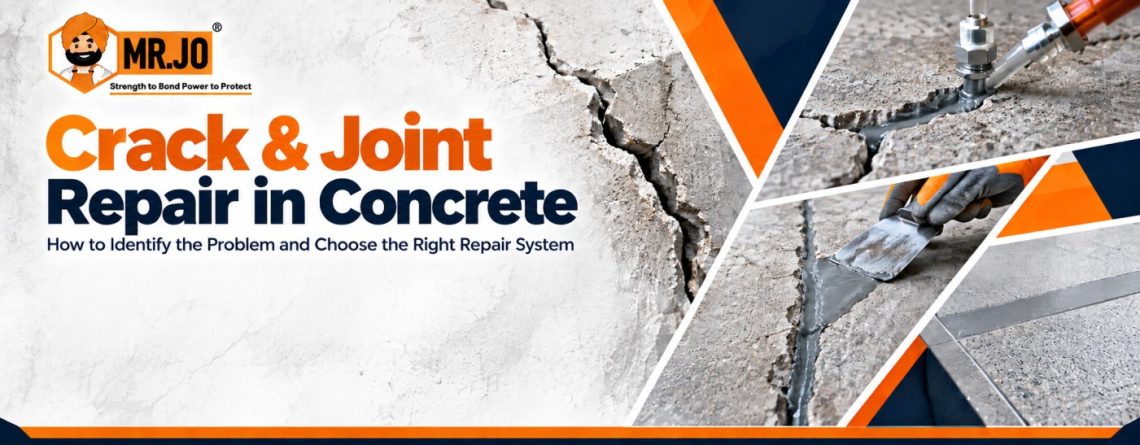
Crack & Joint Repair in Concrete
How to Identify the Problem and Choose the Right Repair System
Identify the problem. Choose the right repair. Restore the structure.
Crack repair is not just about filling a crack. A crack is often the most visible sign of a problem in concrete. The right repair depends on whether the crack is dormant or moving, fine or wide, shallow or deep, dry or moisture-affected, and whether the surrounding concrete or reinforcement has also been damaged.
The objective of a successful repair is to restore the continuity and protection of the concrete, address the condition associated with the cracking, and restore the intended performance of the repaired area.
What Should a Successful Crack Repair Achieve?
- Restore continuity of the concrete so the repaired section can act as a connected body.
- Where a structural crack is suitable for structural epoxy repair, restore the continuity required for the member to transfer loads and stresses in accordance with its structural design.
- Stop water ingress through the repaired path where leakage is being addressed.
- Address reinforcement corrosion where it is associated with the cracking.
- Protect the repaired concrete and extend the service life of the structure.
What Makes a Good Epoxy–Concrete Bond?
A good epoxy bond is more than epoxy simply sticking to concrete. In a properly bonded concrete repair specimen, when the bonded concrete is deliberately loaded to failure, the concrete should fail before the bond fails. In practical terms, the bond should be stronger than the concrete being bonded.
This is why substrate preparation matters. Weak, friable or contaminated concrete must not be treated as a sound bonding surface. If weak concrete at the edge of a repair spalls while the epoxy remains bonded to sound substrate, that is not the same as clean separation at the epoxy–concrete interface.
Start with the Condition, Not the Product
Before choosing a repair material, establish what you are actually repairing:
- Is it a crack or a deliberately provided joint?
- Is the crack dormant or moving?
- Is it fine or wide, shallow or deep?
- Is the concrete around the crack sound, damaged or missing?
- Is reinforcement exposed or showing signs of corrosion?
- Is the substrate dry, damp or wet?
- Is water actively leaking through the crack?
For ordinary dormant cracks, the repair can be straightforward. When one of these conditions changes, the repair method should change with it.
1. Ordinary Dormant Cracks
For a small number of ordinary, dormant cracks in sound concrete, the simplest approach is to prepare the crack properly and fill it with a suitable epoxy repair material.
Recommended approach
- Clean the crack and remove dust, loose particles and weak material. Where necessary, open or dress the crack to obtain sound edges and a suitable repair profile. Prime where required and fill the prepared crack.
MR. JO recommendation
- For a normally prepared, dry concrete surface, MR. JO Primer-MVC is a suitable starting point where a primer is required. For crack filling and fine repair, MR. JO Tecseal-CRP is the general repair-putty option.
- Where the repair area is damp or moisture-affected, MR. JO Tecseal-GRP should be considered instead of CRP where its moisture-tolerant characteristics are required.
- The important distinction is simple: CRP is the normal starting point for a prepared, dry repair; GRP is the alternative when the substrate condition calls for its moisture/underprepared-substrate capability.
2. Many Fine Surface or Shrinkage Cracks
When a concrete surface has a large number of fine, shallow cracks, treating each crack individually may be unnecessary and impractical. The objective can instead be to seal and consolidate the surface as a whole.
Recommended approach
- Prepare the surface to remove dust and weak material, then use a suitable penetrating/sealing system rather than attempting to fill every individual hairline crack.
MR. JO recommendation
- MR. JO Eco Primer P50i can be considered where the objective is to penetrate and seal fine surface imperfections and provide a sound foundation for the subsequent system.
- Where a protective coating is required as part of the finished repair, MR. JO Teckot-RTU can be considered.
- This approach is intended for fine surface cracking. It should not be used to disguise a deep, structural or moving crack.
3. Fine but Deep Structural Cracks
A crack can be very fine at the surface and still extend significantly into the concrete. Surface filling may close the visible opening without repairing the crack through its depth.
Recommended approach
- Where the crack is structurally significant and requires penetration through its depth, epoxy injection is the appropriate repair method. The crack is prepared, injection points are installed as required, the surface is sealed, and the selected injection resin is introduced under the specified procedure.
MR. JO recommendation
- MR. JO Inject-VL is the very-low-viscosity option for fine structural cracks where deep penetration is required.
- Where a crack is suspected to be structural, its significance and repair requirement should be established by the engineer in charge/structural engineer. MR. JO can then assist with product selection and repair methodology.
4. Deep or Narrow Cracks Requiring Injection
Not every deep crack is necessarily a fine structural crack. Where a narrow or deep crack needs epoxy to penetrate beyond the surface, an injection system may be more appropriate than a surface putty.
MR. JO recommendation
- MR. JO Inject-LV is the low-viscosity injection option where low-viscosity penetration is required.
- MR. JO Inject-VL is the very-low-viscosity option where the crack is particularly fine and deeper penetration is required, especially for fine structural cracks.
- MR. JO Inject-MV is the medium-viscosity option where a higher-viscosity injection material is more appropriate, including larger structural cracks or voids.
- MR. JO Inject-UPS is the moisture-tolerant injection option for suitable wet, damp or moisture-affected substrate conditions.
- The final selection should be based on crack geometry, required penetration and substrate condition. Exact crack-width limits should be taken from the applicable product technical data rather than assumed from the product name.
5. Wider Dormant Cracks
A wider dormant crack does not automatically need to be cut. The decision depends on the condition of the crack and whether it can be properly cleaned and filled in its existing geometry.
Repair approach
- If the crack is accessible, the edges are sound and the opening can be adequately filled, routing may not be necessary.
- For injection-type repair, use the appropriate MR. JO Inject grade. Where the opening is sufficiently large to accept a flowable repair mortar, MR. JO Tecrete EWT in Flowable consistency can be considered. Its extended working time gives the applicator more time to place and allow the flowable material to enter the opening.
- Routing is appropriate when weak material needs to be removed, the crack needs to be properly cleaned, the edges are damaged or irregular, or a larger repair profile is needed.
- After preparation, MR. JO Primer-MVC can be used where a primer is required for a normally prepared dry substrate. Fill smaller prepared cracks with MR. JO Tecseal-CRP; use MR. JO Tecseal-GRP where the substrate condition calls for its moisture/underprepared-substrate capability.
- Where the opening is too large for a repair putty to be the practical material, move to MR. JO Tecrete. Select the consistency according to the geometry: Flowable where the material needs to flow into the repair, Tampable where it can be compacted into the opening, and Non-Sag where it must remain in position on vertical or overhead surfaces.
6. Cracks with Concrete Loss
When concrete has broken away around a crack, the repair is no longer simply crack filling. The lost concrete must be reinstated.
Repair approach
- Remove loose and unsound concrete until sound substrate is exposed.
- Clean and prepare the sound concrete and remove dust and contaminants.
- Use the appropriate epoxy priming/bonding approach for the repair system; epoxy primer or the Tecrete system itself is designed to wet and bond to properly prepared concrete.
- Reinstate the lost concrete with MR. JO Tecrete.
- Use MR. JO Tecseal-CRP or MR. JO Tecseal-GRP for fine profiling, edge repair or finishing where required.
- MR. JO Tecrete EWT is selected where extended working time is beneficial. MR. JO Tecrete FWT is selected where faster working/return-to-service is required, subject to the product’s specified cure and application conditions.
- Within the selected Tecrete system, choose Flowable, Tampable or Non-Sag according to repair geometry, depth and orientation.
- For moist or wet substrate conditions, use the appropriate MR. JO Tecrete UPS system.
7. Cracks Associated with Reinforcement Corrosion
Reinforcement corrosion is one of the common conditions associated with cracking and spalling of reinforced concrete. When rust staining, spalling, loose concrete or exposed reinforcement is present, filling the visible crack alone does not address the repair.
Repair approach
- Remove loose and unsound concrete to expose the affected reinforcement.
- Clean the reinforcement and remove corrosion products as required.
- Where additional reinforcement is required, provide it as advised by the structural engineer.
- Protect the cleaned reinforcement with the appropriate MR. JO system.
- Reinstate the lost concrete using MR. JO Tecrete.
- Use MR. JO Tecseal-CRP or MR. JO Tecseal-GRP for finishing and profiling where required.
- If a remaining crack requires injection after the damaged concrete and reinforcement have been addressed, the appropriate MR. JO Inject system can be incorporated.
- The objective is not merely to close the crack. The repair must address the damaged concrete and reinforcement condition so that the environment driving further corrosion is controlled.
8. Moist or Wet Cracks
Moisture changes the repair selection. A product suitable for a dry, prepared substrate should not automatically be assumed to be suitable when the concrete is damp or wet.
MR. JO recommendation
- Where the substrate is moisture-affected, use the appropriate MR. JO UPS system according to the repair requirement.
- MR. JO Primer-UPS — where a moisture-tolerant primer is required.
- MR. JO Inject-UPS — where injection is required under wet/damp/moist conditions.
- MR. JO Tecseal-GRP — where a moisture-tolerant repair putty is appropriate.
- MR. JO Tecrete UPS — where lost concrete must be reinstated under suitable wet/moist conditions.
- The condition still needs to be understood: moisture-affected is not the same as an actively leaking crack.
9. Actively Leaking Cracks
An actively leaking crack should not simply be filled with epoxy while water is continuing to enter. The source or path of water must first be stopped or controlled.
MR. JO recommendation
- Once the leakage condition has been addressed, the appropriate MR. JO repair system can be selected.
- Where the remaining repair is to be carried out on a wet/moist substrate, the MR. JO UPS range provides options for priming, injection, filling and concrete reinstatement.
- If the source of leakage or the condition of the crack is uncertain, call MR. JO before selecting the repair system.
10. Moving Cracks
A moving crack is different from a dormant crack. A rigid epoxy repair should not be selected simply because the crack is visible and accessible.
MR. JO recommendation
- The movement and structural significance should first be assessed by the engineer in charge or structural engineer. Once the movement issue has been addressed and a rigid repair is appropriate, the relevant MR. JO repair method can be selected.
- Where structural strengthening is required as part of the designed repair, MR. JO Matrix-SF can be used with suitable carbon or glass fibre reinforcement. MR. JO Tecseal-NSA can be considered where a non-sag structural adhesive is required as part of the strengthening design.
- If a crack is moving, structurally significant or difficult to assess: call MR. JO.
11. Damaged Construction or Control Joints
A construction or control joint is not simply a crack. It was created intentionally as part of the concrete construction and its intended function should be understood before repair.
MR. JO recommendation
- Where the joint edges have deteriorated, remove loose material and restore the damaged geometry. Use MR. JO Tecseal-CRP or MR. JO Tecseal-GRP for suitable fine edge repairs and finishing, and MR. JO Tecrete where substantial concrete reinstatement is required.
- The objective is to restore the damaged concrete without unintentionally changing the intended function of the joint.
12. Damaged Movement or Expansion Joints
Movement and expansion joints are intended to accommodate movement. Their repair therefore requires more than filling an opening with a rigid material.
MR. JO recommendation
- Damaged concrete edges and joint geometry can be restored using suitable MR. JO repair materials.
- The repair must preserve the movement function of the joint rather than locking it solid.
- If the joint type, movement requirement or repair detail is uncertain, call MR. JO and the engineer in charge before proceeding.
A Simple MR. JO Decision Guide
| What You See | What the Repair Needs to Do | MR. JO Starting Point |
| Few ordinary dormant cracks | Fill and seal the prepared crack | MR. JO Primer-MVC + MR. JO Tecseal-CRP; use MR. JO Tecseal-GRP where moisture/underprepared-substrate capability is required. |
| Many fine surface cracks | Seal/penetrate the surface rather than repair every crack individually | MR. JO Eco Primer P50i; MR. JO Teckot-RTU where a protective coating is required. |
| Fine structural crack requiring deep penetration | Inject through the crack | MR. JO Inject-VL. |
| Deep/narrow crack requiring low-viscosity penetration | Inject | MR. JO Inject-LV. |
| Larger structural crack or void | Inject with a higher-viscosity system where appropriate | MR. JO Inject-MV. |
| Wide crack or substantial opening | Rebuild the opening with an epoxy repair mortar | MR. JO Tecrete EWT or MR. JO Tecrete FWT; choose F/T/N by geometry. |
| Concrete loss with moisture-affected substrate | Reinstate the lost concrete under moisture-affected conditions | MR. JO Tecrete UPS; use MR. JO Tecseal-GRP for suitable fine finishing. |
| Crack with reinforcement corrosion | Treat reinforcement and damaged concrete, then reinstate | Clean/protect reinforcement + MR. JO Tecrete; assess injection if required. |
| Active leakage | Stop/control water before rigid epoxy repair | Call MR. JO. |
| Moving or structurally significant crack | Assess movement/structure before rigid repair | Engineer/structural engineer + Call MR. JO. |
| Damaged movement joint | Restore edges while preserving movement | MR. JO repair system selected to suit the joint detail; call MR. JO if uncertain. |
When Should You Call MR. JO?
You do not need to diagnose every crack yourself. Call MR. JO when the crack is moving, actively leaking, associated with significant reinforcement corrosion or structural damage, or when the appropriate repair method is not clear.
For structural members and structurally significant cracks, the engineer in charge or structural engineer remains responsible for assessing the structural condition and defining any required structural intervention. MR. JO can assist with the selection and application of the appropriate epoxy repair system.
Related MR. JO Solutions
- MR. JO Tecseal series — crack filling, repair and finishing.
- MR. JO Inject series — epoxy injection for crack and void repair.
- MR. JO Tecrete — epoxy repair mortars for concrete reinstatement.
- MR. JO Primer series — primers selected according to substrate and moisture condition.
- MR. JO Matrix-SF — fibre-composite structural strengthening systems.
- MR. JO Tecseal-NSA — non-sag structural adhesive where specified in strengthening applications.
Technical Note: For product-specific application limits, mix ratios, curing, surface preparation and technical properties, refer to the applicable MR. JO product page and Technical Data Sheet.




Leave a Reply