

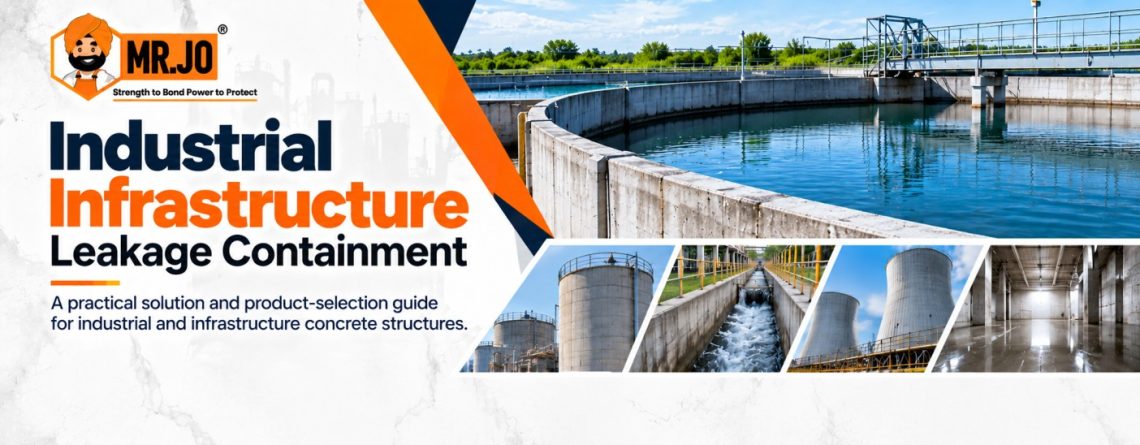
Industrial & InfrastructureLeakage, Containment & Protection
Keep liquids in. Keep leakage out. Protect the structure.
A practical solution and product-selection guide for industrial and infrastructure concrete structures.
1. Start with the structure
Industrial structures are often required to contain water, effluent, process liquids or chemicals while remaining leak-tight and serviceable. The solution depends not only on where leakage is seen, but on the structure, the leakage path, the substrate condition and the service environment.
| Structure / application | Typical concern |
| Water tanks & reservoirs | Leakage, cracks, honeycombing, construction-joint leakage, concrete deterioration and internal voids |
| ETP / STP / WTP / DM / RO plants | Tank and drain leakage, wet repair, concrete deterioration and chemical/process exposure |
| Cooling towers | Deteriorated or corroded concrete, cracks, leakage, wet areas and concrete reinstatement |
| Industrial process & chemical structures | Containment, leakage, aggressive-liquid exposure and concrete protection |
| Sumps, pits, drains & channels | Continuous wet service, leakage, damaged edges, cracks and concrete loss |
| Industrial containment / bunds | Liquid containment, concrete deterioration and chemical exposure |
| Underground & utility structures | Tanks, chambers, pump pits, trenches and moisture-affected concrete |
| Marine & coastal structures | Wet/moist concrete, cracks, deterioration and repair/protection requirements |
| Bridges & infrastructure | Cracks, concrete deterioration, leakage paths and rehabilitation |
2. Then identify the containment problem
| If you have… | Start by considering… |
| Water / process liquid leakage | Find the leakage path before choosing the surface treatment: crack, joint, void, porous concrete, interface or failed coating. |
| Leakage through a crack | Surface sealing plus injection where the leakage path extends into the concrete. |
| Construction-joint leakage | Treat the leakage path and interface; Inject-UPS where wet injection is required and the product/application conditions are appropriate. |
| Honeycombing / internal voids | Small accessible voids may be repaired at the surface; deep/inaccessible voids may require injection followed by reinstatement. |
| Concrete loss / deterioration | Repair the damaged concrete first, then protect the repaired structure where required. |
| Wet / damp substrate | Use a system intended for the actual moisture condition; UPS systems are important where moisture cannot be eliminated. |
| Chemical / aggressive-liquid exposure | Identify the actual liquid, concentration, temperature and exposure before selecting protection. |
| Movement / expansion joint | Repair damaged edges but preserve the movement function; do not fill a movement joint with rigid epoxy. |
| Structural damage / rehabilitation | Repair the substrate first and follow the designed structural repair or strengthening route. |
| MR. JO approach Leakage and protection are not automatically the same problem. First identify and address the leakage path or damaged concrete. Then select the protection system for the service environment. |
3. Find the leakage path
A visible wet spot or leaking face is not necessarily the point where water or process liquid is entering or escaping. The path may run through a crack, construction joint, honeycombing, porous concrete or an interface.
| Observed condition | Likely repair route | MR. JO starting point |
| Surface-visible, accessible defect | Seal / fill / profile | MR. JO Tecseal-CRP or Tecseal-GRP as appropriate |
| Fine structural crack extending into concrete | Injection | MR. JO Inject-VL |
| Fine / deeper crack | Low-viscosity injection | MR. JO Inject-LV |
| Larger crack / internal void / deep honeycombing | Higher-viscosity injection | MR. JO Inject-MV |
| Wet / damp injection condition | Moisture-compatible injection | MR. JO Inject-UPS |
| Concrete loss around leakage path | Reinstate concrete | MR. JO Tecrete EWT / FWT / UPS as applicable |
| Old concrete → new concrete | Interface bonding | MR. JO Bondkot selected for condition and geometry |
| Surface protection after repair | Protective coating | MR. JO Protectokot family selected for service environment |
4. Dry, damp, wet or actively leaking?
Moisture condition is a material-selection factor. A system intended for a dry, prepared substrate should not automatically be used on wet or moisture-affected concrete.
| Site condition | What it means for the repair |
| Dry, sound substrate | Normal preparation and the specified dry-substrate system may be used. |
| Damp / moisture-affected | Select a system whose intended application includes the actual moisture condition; UPS options may be relevant. |
| Wet / waterlogged concrete | Use a moisture-compatible system where the product is intended for this condition. |
| Active leakage | Control the source/path sufficiently before treating the area as an ordinary surface repair or coating. |
| Water under uncontrolled pressure | Do not simply cover the flowing water with epoxy. Control the water condition first, then execute the selected repair. |
| Important distinction Damp concrete and active water are different conditions. Moisture-tolerant epoxy can help where the product is designed for it; it does not mean uncontrolled water pressure can simply be coated over. |
5. Leakage through cracks and joints
Cracks
If a leaking crack continues into the concrete, filling only the visible opening may leave the internal leakage path untreated. Where injection is required, the crack surface is sealed, injection ports are installed, communication is established and the selected Inject grade is introduced progressively.
| Condition | MR. JO route |
| Fine structural crack | MR. JO Inject-VL — very-low-viscosity route where deep penetration is required |
| Fine / deeper crack | MR. JO Inject-LV — low-viscosity injection |
| Larger crack / internal void | MR. JO Inject-MV — medium-viscosity injection |
| Wet / damp injection | MR. JO Inject-UPS |
| Crack sealing / injection-port fixing | MR. JO Tecseal-CRP / Tecseal-GRP as appropriate |
Construction joints
A construction joint is an intentional interface, not simply a crack. If it is leaking, the repair should address the leakage path and the condition of the interface. Where wet injection is required, MR. JO Inject-UPS is a key option subject to the site and product conditions.
Movement / expansion joints
Movement joints are intended to accommodate movement. Repair damaged concrete edges if required, but preserve the movement function. Do not fill a movement joint solid with rigid epoxy. The final joint treatment should be suitable for the movement expected.
6. Honeycombing, voids and concrete loss
| Situation | MR. JO route |
| Small honeycombing / narrow crevices | Tecseal-CRP / Tecseal-GRP can be used where suitable |
| Larger concrete loss | Tecrete EWT / FWT; select Flowable, Tampable or Non-Sag according to geometry |
| Wet / moist concrete reinstatement | Tecrete UPS where the product/application conditions are appropriate |
| Deep / inaccessible honeycombing | Consider injection to reach internal voids, then reinstate the exposed/lost concrete |
| Substantial concrete loss | Conventional concrete may be more appropriate; Bondkot-HV can provide the old-to-new concrete bonding interface where specified |
If the visible face is closed while a significant void remains behind it, the defect may have been hidden rather than properly repaired.
7. Old concrete to new concrete
Bondkot is an interface-bonding family. Selection depends on moisture, surface condition, penetration requirement, gaps and application geometry.
| Site condition / requirement | MR. JO Bondkot |
| Wet / damp / moisture-affected concrete | Bondkot-UPS |
| Uneven surface, small gaps, vertical or overhead application | Bondkot-HV |
| General old-to-new bonding on a prepared surface | Bondkot-MVC |
| Porous / absorbent concrete where penetration is important | Bondkot-LVC |
8. Repair first. Protect second.
Where an industrial structure is exposed to water, effluent, chemicals, abrasion or other aggressive service conditions, surface protection is a separate decision from concrete repair. First restore sound concrete and interfaces. Then select the protective system.
| MR. JO. system | Practical positioning |
| MR. JO Protectokot-BLK | Coal-tar epoxy system for industrial waterproofing, corrosion/chemical protection and applications including ETPs and industrial structures |
| MR. JO Protectokot-CR | Slower-curing polyamine-based clear resin / brown hardener system |
| MR. JO Protectokot-CRH | Clear novolac-based protective system |
| MR. JO Protectokot-HB | Grey, high-build novolac system; 100:20 ready-to-use pack |
| MR. JO Protectokot-HBCR | High-build coloured chemical-resistant coating, normally supplied in green |
| Chemical selection is service-specific Do not select a protective coating from the chemical name alone. Check the actual liquid, concentration, temperature and exposure (immersion, splash/spillage, abrasion etc.) against the applicable MR. JO technical documentation. |
9. Structure-specific problems — where do I start?
| If your problem is… | Start here |
| ETP tank leakage | Identify whether leakage is through cracks, construction joints, honeycombing or porous concrete; repair/inject first, then select protection for the actual effluent environment. |
| STP / WTP / DM / RO tank leakage | Use the same leakage-path approach; moisture condition and service liquid determine the repair/protection route. |
| Cooling tower leakage / deterioration | Assess cracks, concrete loss, corrosion, wet conditions and leakage paths; use repair/injection and then protection where required. |
| Industrial drain / channel leakage | Assess continuous wet exposure, cracks, damaged edges and concrete loss; select moisture-compatible repair where required and protection for service exposure. |
| Chemical tank / containment area deterioration | Repair damaged concrete and then select Protectokot according to the actual chemical and exposure conditions. |
| Water reservoir / tank leakage | Trace the leakage path; use crack/joint repair or injection as required, then protect the repaired concrete where specified. |
| Marine / coastal concrete repair | Account for wet/moist conditions, concrete deterioration and the required service environment; select moisture-compatible repair/protection systems as appropriate. |
| Underground chamber / pit leakage | Determine whether the issue is crack, joint, porous concrete or construction defect; control active water and then select the repair route. |
10. Structural rehabilitation — when leakage is not the whole problem
Some industrial and infrastructure structures have both a containment problem and a structural rehabilitation requirement. Repair damaged concrete and internal defects first where required. If structural capacity also needs to be restored or enhanced, follow the designed strengthening route.
| Requirement | MR. JO role |
| Concrete reinstatement | Tecrete EWT / FWT / UPS as applicable |
| Crack / void repair | Inject-VL / LV / MV / UPS as applicable |
| Substrate preparation | Primer-UPS where specified |
| Fabric-based strengthening | Matrix-SF as the epoxy saturant / impregnating resin |
| Prefabricated laminate bonding | Tecseal-NSA as the specified non-sag structural adhesive |
Fibre type, orientation, number of layers, laminate/fabric configuration and strengthening extent are determined by the project repair or structural engineer, not by the epoxy supplier.
11. Quick MR. JO leakage → product selector
| Customer problem | MR. JO starting point |
| Fine structural leakage crack | Inject-VL |
| Fine / deeper crack | Inject-LV |
| Larger crack / internal void | Inject-MV |
| Wet / damp injection | Inject-UPS |
| Crack sealing / injection ports | Tecseal-CRP / Tecseal-GRP |
| Small honeycombing / crevice | Tecseal-CRP / Tecseal-GRP |
| Larger concrete reinstatement | Tecrete EWT / FWT |
| Wet/moist concrete reinstatement | Tecrete UPS |
| Old/new concrete — uneven / gap / vertical | Bondkot-HV |
| Old/new concrete — general prepared surface | Bondkot-MVC |
| Old/new concrete — porous / absorbent | Bondkot-LVC |
| Old/new concrete — wet / damp | Bondkot-UPS |
| Industrial water / chemical protection | Protectokot family — select by service environment |
| Structural strengthening | Primer-UPS / Matrix-SF / Tecseal-NSA, as designed |
12. When the answer is not obvious — involve MR. JO
Some containment and leakage problems should not be reduced to a product name without understanding the structure and service conditions.
The leakage is under uncontrolled water or process-liquid pressure.
The chemical, concentration or temperature is unknown.
The structure is moving or a movement joint may be involved.
Reinforcement damage or concrete deterioration is extensive.
The leakage path is internal or inaccessible.
The repair also involves structural rehabilitation or strengthening.
A previous repair or coating has failed and the reason is unclear.
| Send us the basics Structure / application • photographs • leakage location and pattern • crack/defect dimensions • dry/damp/wet condition • liquid/chemical and concentration where relevant • repair depth/size • existing coating/repair details • whether structural repair or strengthening is involved. |
13. MR. JO as your epoxy technology partner
| MR. JO can help with | What that means |
| Select | Help narrow down the appropriate epoxy repair, injection, bonding or protection system. |
| Supply | Provide the selected system for project requirements with responsive, project-oriented supply. |
| Develop / customise | Work toward a customised solution where an existing product is not the right fit. |
| Application support | Nearby site support where practical; video-based technical/application support for projects farther away. |
You bring the structure and the containment or repair requirement. MR. JO helps identify the epoxy system, provides the material and supports the application.
14. Related MR. JO solution guides
MR. JO Crack & Joint Repair — crack and joint repair selection
MR. JO Concrete Repair — concrete defect and reinstatement solutions
MR. JO Concrete Injection — injection methodology and resin selection
MR. JO Structural Strengthening — epoxy systems for designed strengthening applications
MR. JO Concrete Surface Protection — protective epoxy systems for industrial exposure
MR. JO Building Waterproofing — building and wet-area waterproofing solutions
MR. JO — Keep liquids in. Keep leakage out. Protect the structure.
For product-specific application limits, mix ratios, curing, surface preparation and technical properties, refer to the applicable MR. JO product page and Technical Data Sheet.


Leave a Reply